Conscious Leadership
Somatic Intelligence
From Reactive to Responsive Leadership
A Founder's Roadmap to Stay Centered Under Pressure
The Slack message comes in. Your co-founder questioning your decision. Again.
Your chest tightens. Your jaw clenches. Before you've even thought about what to say, your fingers are typing a defensive response.
You hit send. Then immediately wish you hadn't.
This is reactivity. Your nervous system takes over before your thinking brain has a chance. The reaction happens faster than conscious thought. And it almost always makes things worse.
Most founders know they're reactive. What they don't know is that reactivity isn't a personality flaw - it's a nervous system pattern. And like any pattern, it can be retrained.
The difference between reactive and responsive leadership isn't personality. It's practice. Here's the roadmap.
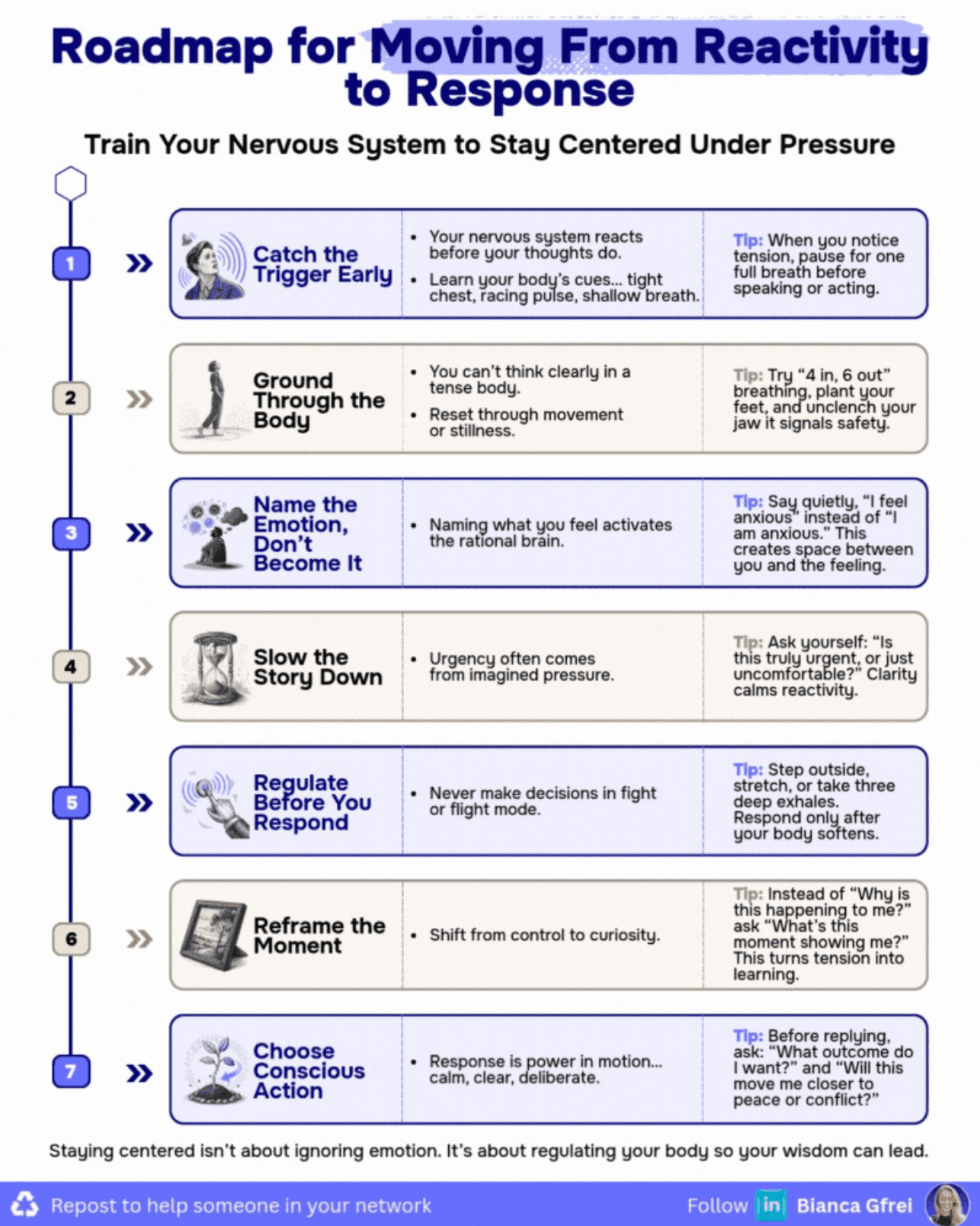
Step 1: Catch the Trigger Early
Your nervous system reacts before your thoughts do.
This is biology. When your system perceives threat - a challenging email, a difficult conversation, an unexpected problem - it activates immediately. Heart rate increases, breathing shallows, thoughts race or freeze.
Most founders don't notice this activation until they're already deep in reaction. You're mid-argument before you realize you're activated. You've sent the email before you notice your hands were shaking.
Learn your body's cues: Tight chest. Racing pulse. Shallow breath. Clenched jaw. Tense shoulders. Heat rising. These are your early warning system.
The moment you notice any of these signals, you have a choice:
Keep going and let reactivity run the show.
Or pause.
Tip: When you notice tension, pause for one full breath before speaking or acting. Just one breath creates space between trigger and response.
Step 2: Ground Through the Body
You can't think clearly in a tense body.
When your nervous system is activated, your prefrontal cortex - the part responsible for strategic thinking, perspective, and clear communication - goes offline. You're operating from survival mode while trying to make complex leadership decisions.
You cannot think your way into regulation. You have to work with your body.
Reset through movement or stillness. Stand up. Stretch. Unclench your jaw. Plant your feet. Feel the ground beneath you. Take a few intentional breaths.
Physical grounding tells your nervous system it's safe to stand down. Movement releases the activation that builds up in your body. Stillness gives your system permission to settle.
Tip: Try "4 in, 6 out" breathing. Plant your feet. Unclench your jaw - this signals safety to your nervous system.
I used to skip this step. I thought I could regulate through thinking. I was wrong. Your body has to shift before your mind can follow.
Step 3: Name the Emotion, Don't Become It
Naming what you feel activates the rational brain.
When you're in the grip of an emotion - anger, anxiety, frustration - you become it. "I AM angry." The emotion and your identity merge. You're not experiencing anger. You are anger.
Naming creates distance. "I feel angry" instead of "I am angry." That small shift changes everything. You're no longer the emotion. You're the person experiencing the emotion.
This isn't semantic. It's neurological. When you name an emotion, you activate your prefrontal cortex. The act of labeling literally helps regulate the emotional response.
Tip: Say quietly, "I feel anxious" instead of "I am anxious." This creates space between you and the feeling. You're not denying the emotion. You're observing it instead of being consumed by it.
Most founders resist this because it feels too simple. It is simple. It's also powerful.
Step 4: Slow the Story Down
Urgency often comes from imagined pressure.
Your mind creates stories faster than you can examine them. "This is a disaster." "They don't respect me." "We're going to lose this deal." "I'm failing."
These stories feel true. They feel urgent. They activate your nervous system as if they're already happening.
But most of the time? They're not true. They're your system's interpretation of a situation based on old patterns and fear.
Ask yourself: "Is this truly urgent, or just uncomfortable?" Most of what feels urgent is actually just uncomfortable. Your system conflates the two.
Clarity calms reactivity. When you slow down enough to question the story, you often realize the urgency is imagined. The situation is challenging, yes. But not the emergency your nervous system is treating it as.
Tip: Ask yourself: "Is this truly urgent, or just uncomfortable?" Clarity calms reactivity. Most founders react to discomfort as if it's danger.
Step 5: Regulate Before You Respond
Never make decisions in fight or flight mode.
This is the most important step. Everything before this prepares you for this moment.
When you're activated - heart racing, thoughts spinning, body tense - your decision-making is impaired. You're not choosing from wisdom. You're choosing from survival.
Decisions made from activation almost always create more problems. The email you send while angry. The conversation you have while defensive. The choice you make while panicked.
These decisions feel right in the moment. They rarely are.
Wait. Step outside. Stretch. Take three deep exhales. Do not respond until your body softens. When your breathing steadies, when your jaw unclenches, when your thoughts slow down - that's when you're ready to respond.
Tip: Step outside, stretch, or take three deep exhales. Respond only after your body softens. This isn't delay - it's discipline.
Step 6: Reframe the Moment
Shift from control to curiosity.
Reactivity is rooted in the need to control. Control the outcome. Control how you're perceived. Control the other person's response.
The shift to responsiveness requires letting go of control and moving into curiosity.
Instead of "Why is this happening to me?" ask "What is this moment showing me?" Instead of trying to fix, defend, or prove, get curious about what's actually happening.
Tension becomes information. When you stop resisting the moment and start examining it, you learn. Why did that trigger me? What old pattern just got activated? What does my reaction tell me about what I value?
Tip: Instead of "Why is this happening to me?" ask "What's this moment showing me?" This turns tension into learning.
Step 7: Choose Conscious Action
Response is power in motion - calm, clear, deliberate.
You've caught the trigger. Grounded your body. Named the emotion. Slowed the story. Regulated your system. Reframed the moment.
Now you respond.
Not from reaction. Not from the first impulse your nervous system generated. From conscious choice.
Before replying, ask: "What outcome do I want?" and "Will this move me closer to peace or to conflict?"
These questions interrupt autopilot. They force you to choose your response based on your values and goals, not your activation.
Response is power in motion. Not rushed. Not suppressed. Calm, clear, deliberate action from a regulated state.
Tip: Before replying, ask: "What outcome do I want?" and "Will this move me closer to peace or conflict?"
This is leadership. Not reacting to everything that activates you. Responding from center to what actually matters.
Why This Roadmap Works (And Why It Takes Practice)
These seven steps aren't complicated. You could memorize them in five minutes.
Living them? That takes practice.
Your nervous system has spent years learning to react quickly. React to threat. React to discomfort. React to uncertainty. Those patterns are deeply wired.
Shifting from reactivity to response means building new neural pathways. That doesn't happen from reading. It happens from repetition. From catching yourself mid-reaction and choosing differently. Again and again.
You'll forget. You'll react instead of respond. You'll skip steps. That's not failure - that's the process.
What matters is catching yourself. Maybe not before the reaction, but during it. Or after it. Each time you notice, you're building awareness. Each time you pause, you're strengthening regulation. Each time you choose response over reaction, you're retraining your system.
The founders who move from reactive to responsive aren't the ones who never get triggered. They're the ones who've practiced these steps enough that they become second nature.
What Changes When You Practice This
I spent years leading from reactivity. Quick to defend. Quick to respond. Quick to react to anything that felt like a threat or criticism.
It cost me. Relationships with my co-founder. Trust with my team. Decisions I couldn't take back.
Learning to regulate before responding changed everything. Not just for me - for everyone around me. Hard conversations became possible. Conflict became productive instead of destructive.
Staying centered isn't about ignoring emotion. It's about regulating your body so your wisdom can lead.
When you practice this roadmap consistently:
You stop creating problems from reactivity
People trust you with difficult conversations
You make better decisions under pressure
Your team learns to do the same by watching you
You build a culture where regulation is valued over reaction
This is the leadership edge most founders are missing.
Staying centered isn't about ignoring emotion. It's about regulating your body so your wisdom can lead.
— Bianca
Go deeper
Download the
CheatSheat
Ready to Upgrade Your Founder OS?
If you're recognizing yourself in these patterns and ready for more than quick fixes, the REWIRED program applications open January 2026. Six months of nervous system work, emotional mastery, and founder community.
Applications open January 2026 - Cohort starts March 2026