Boundaries & Communication
Conscious Leadership
The 8-Step Conflict Regulation Guide for Founders
How to Handle Tension Without Losing Your Calm
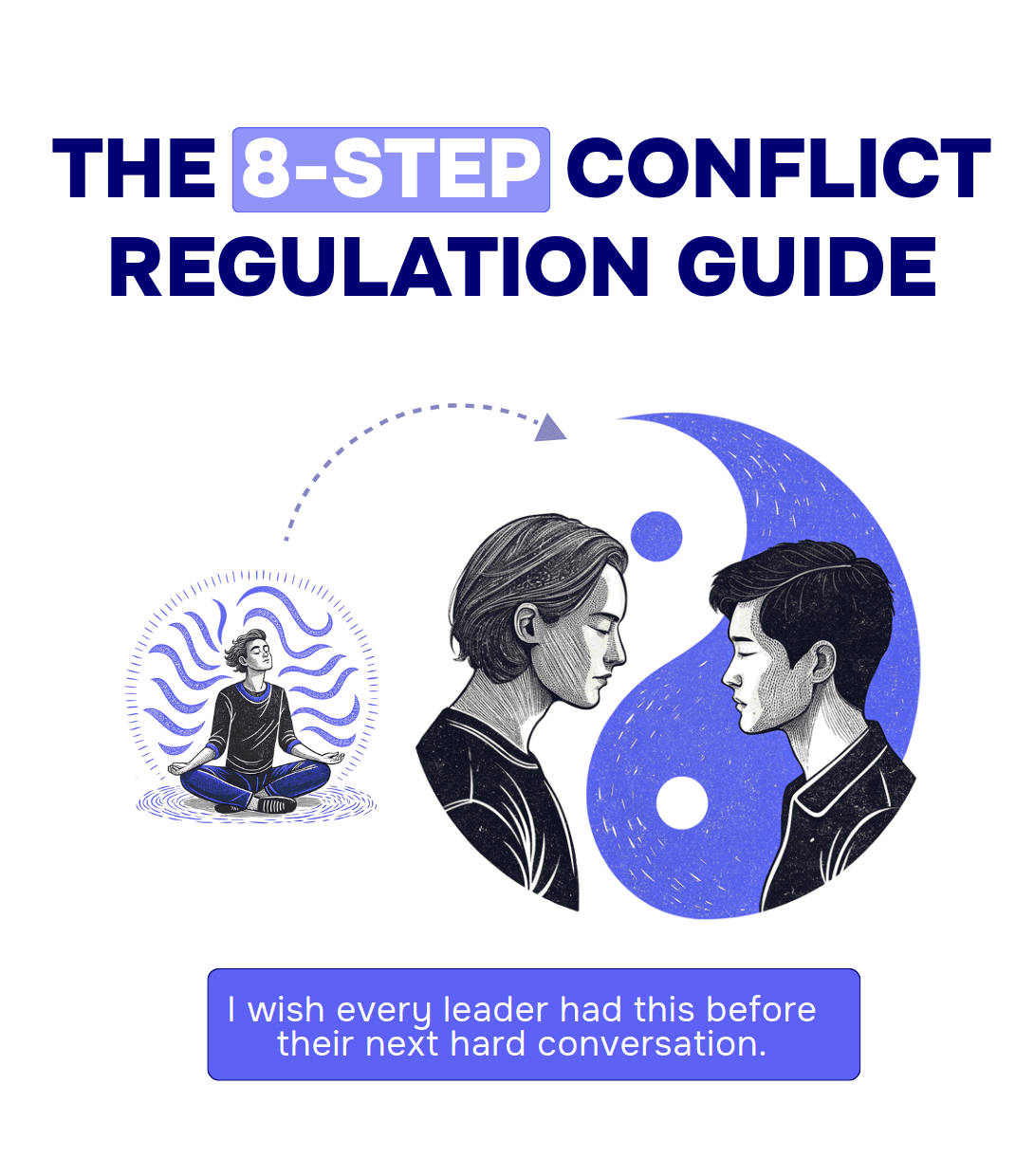
You're about to have a tough conversation with your co-founder. Your chest is tight. Your thoughts are racing between what you want to say and what might go wrong.
You know this conversation needs to happen. But you also know you don't trust yourself when you're this activated.
Here's what most founders don't realize: You don't avoid conflict because you fear the other person. You avoid it because you fear your own reaction. You fear saying something you'll regret. Shutting down when you need to speak up. Letting emotion hijack the conversation you intended to have with clarity.
Unregulated emotions make conflict unsafe. Regulated emotions make it productive.
The difference between leaders who navigate conflict well and those who avoid it isn't courage - it's regulation. Here's how to stay grounded when things get tense.
Step 1: Regulate First
Before replying, slow your breath. Name what you feel: "I'm tense," "I'm frustrated."
You can't communicate clearly with a charged nervous system. When your heart is racing and your body is activated, your prefrontal cortex - the part responsible for strategic thinking and clear communication - goes offline. You're operating from threat mode.
The pause isn't optional. It's the difference between saying what you mean and saying what you'll regret.
Three breaths. Name the emotion. Feel your feet on the ground. Then speak.
Step 2: Validate Before You Speak
"I understand why this matters to you."
Validation lowers defensiveness. When someone feels heard, their nervous system relaxes. Being heard relaxes the body for both of you.
This isn't about agreeing. It's about acknowledging their perspective before presenting yours. Most conflicts escalate because both people are fighting to be heard. When you validate first, you stop the fight.
Step 3: Ask, Don't Assume
"Can you help me understand your view?"
Curiosity shifts the energy from confrontation to collaboration. When you assume you know what they're thinking, you create resistance. When you ask, you create space for actual dialogue.
Most of us enter conflict with our story already written. "They're being defensive." "They don't get it." "They're not listening." Those assumptions create the very dynamic you're trying to avoid.
Ask instead of assume. You'll be surprised how often your story was wrong.
Step 4: Own Your Impact
Use "I feel" instead of "You made me feel."
Owning your response turns accusation into awareness. "You made me feel dismissed" creates defensiveness. "I felt dismissed" creates space for understanding.
This isn't semantics. It's taking responsibility for your emotional experience while still naming what happened. You're not blaming them for your feelings. You're sharing your experience as information.
Step 5: Anchor in Common Ground
"We both want to solve this."
Shared goals regulate the space and open new options. When conflict gets heated, both people forget they're on the same team. Anchoring in common ground reminds you both why this conversation matters.
You're not opponents. You're two people trying to navigate something difficult together. Return to that shared intention whenever the conversation starts to spiral.
Step 6: Stay in the Present
Don't bring old stories into new conversations. Focus on what's happening now, not what happened before.
"You always do this" escalates everything. It pulls in history and turns one situation into a pattern you're both now defending or attacking. The present moment has enough tension without adding the weight of the past.
Stay here. Stay now. Address this specific situation. Old patterns can be discussed separately, when both of you are regulated and ready.
Step 7: Use Calming Language
"I wonder if..." instead of "You always..."
The words you use either trigger or regulate. Absolutes like "always" and "never" activate defensiveness. Soft language like "I wonder" or "I'm curious" invites dialogue.
Choose presence over proof. You're not trying to win the argument. You're trying to resolve the tension. The language you use determines which path you take.
Step 8: Pause Before Responding
A few seconds of silence restores perspective.
When they say something that triggers you, pause. Breathe. Answer from regulation, not reaction.
The silence feels uncomfortable. That discomfort is exactly why most people skip it. But those few seconds are where you shift from reactive to conscious. From escalating to de-escalating.
Pause, breathe, and respond. Not react.
Why This Works (And Why It's Hard)
These eight steps aren't complicated. They're simple. But simple doesn't mean easy.
Here's why it's hard: Years of conditioning have trained you to react quickly. To defend yourself. To prove you're right. To match their energy. Those patterns run deep.
Staying regulated when someone else is activated requires you to do the opposite of what your nervous system wants to do. Your system wants to fight back or shut down. These steps ask you to stay present instead.
That's not weakness. That's leadership.
The leaders who navigate conflict well aren't the ones who never get activated. They're the ones who've practiced staying regulated even when their system wants to react. They've built the muscle of the pause. The habit of validation. The reflex of curiosity over assumption.
This is a practice, not a perfect. You'll mess up. You'll react instead of respond. You'll forget to pause or validate or stay present. That's normal.
What matters is catching yourself. Noticing when you've gotten activated. Naming it, regulating, and trying again.
What Changes When You Practice This
When you lead conflict from regulation instead of reaction, everything shifts:
Trust deepens because people know you won't weaponize their vulnerability. Hard conversations happen sooner because you're not avoiding them out of fear. Resentment decreases because issues get addressed before they accumulate. Your team watches how you handle conflict and learns to do the same.
Conflict doesn't destroy relationships. Dysregulation does.
The founders and leaders who build cultures of trust aren't the ones who avoid tension. They're the ones who've learned to stay calm within it.
"Save this for your next tough conversation. The conflict you're avoiding won't resolve itself. But you can learn to navigate it without losing yourself in the process."
— Bianca
Go deeper
Download the
Guide
Ready to Upgrade Your Founder OS?
If you're recognizing yourself in these patterns and ready for more than quick fixes, the REWIRED program applications open January 2026. Six months of nervous system work, emotional mastery, and founder community.
Applications open January 2026 - Cohort starts March 2026