Somatic Intelligence
Founder Burnout
Burnout in Action: The Hidden Psychology & Drivers Behind
9 Patterns That Look Like Dedication But Are Depletion
You're working 12-hour days. Hitting your metrics. Getting things done.
Everyone thinks you're crushing it.Inside? You're collapsing.
This is burnout in action. Not the dramatic breakdown. The slow erosion disguised as high performance.
The patterns that look like leadership, dedication, and strength from the outside - but feel like exhaustion, emptiness, and depletion on the inside.
Most founders don't recognize burnout until they're already deep in it. Because burnout doesn't start with collapse.
It starts with psychological patterns that our culture celebrates:
Hustle. Achievement. Never slowing down. Pushing through.
Here are nine patterns burning you out while everyone applauds your work ethic.
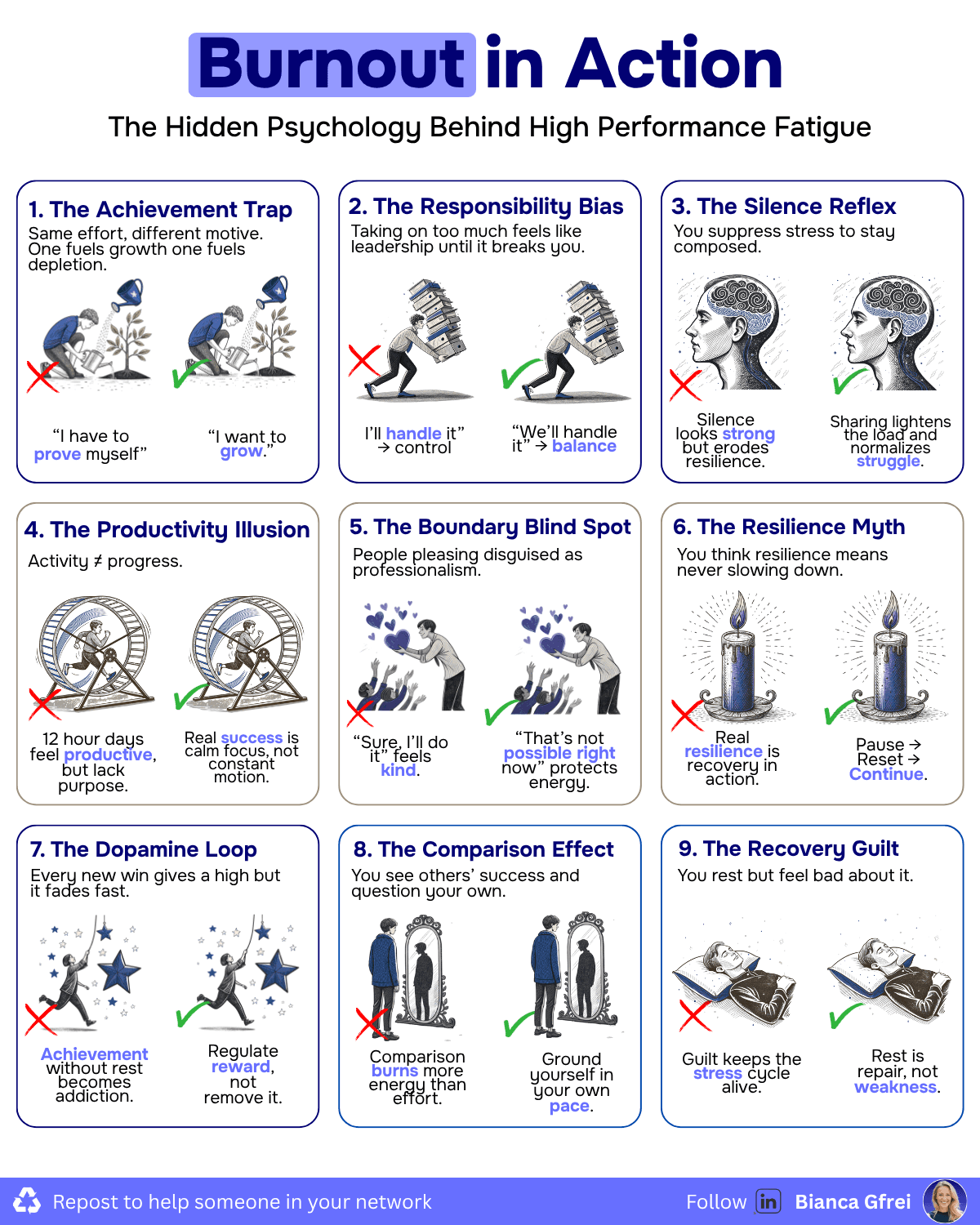
Pattern 1: The Achievement Trap
Same effort, different motive. One fuels growth, one fuels depletion.
There's a version of you that works hard because you want to grow. You're excited. Curious. Building something meaningful. The work energizes you even when it's difficult.
Then there's the version that works hard because you need to prove yourself. To investors. To your team. To yourself. "I have to prove myself" becomes the fuel. And that fuel is toxic.
The difference: Growth-driven work restores you. Proof-driven work depletes you.
When achievement becomes about validating your worth rather than expressing your vision, every success feels empty. You hit the milestone and immediately look for the next one. The dopamine fades fast. Nothing is ever enough.
You're running on a treadmill, working just as hard, but going nowhere. The exhaustion isn't from the work itself - it's from working to prove something that can never be proven enough.
The shift: Notice the voice driving you. "I want to build this" feels different in your body than "I have to prove I can." One expands. One contracts.
Pattern 2: The Responsibility Bias
Taking on too much feels like leadership until it breaks you.
You tell yourself you're the only one who can do it right. That delegating would take longer than just doing it yourself. That your team needs you to carry them.
The reality: "I'll handle it" is control masquerading as responsibility. And "We'll handle it" is balance.
Taking everything on feels noble. It looks like leadership. It impresses your board. But it's unsustainable.
Every task you don't delegate is a piece of yourself you give away. Your decision-making capacity drains. Your strategic thinking narrows. You become reactive instead of visionary because you're drowning in execution.
The hidden cost: When you carry everything, you train your team to be helpless. They stop thinking for themselves. They wait for you to decide, to solve, to rescue. You've created the dependency you now resent.
The shift: Balance means distributing the load, not carrying it heroically until you break. Delegation isn't weakness - it's multiplying your impact through others.
Pattern 3: The Silence Reflex
You suppress stress to stay composed. Silence looks strong but erodes resilience.
Something goes wrong. You feel the panic, the frustration, the fear. But you don't say it. You compose yourself. You handle it internally. You show up to the next meeting like nothing happened.
This feels like strength. It looks professional. People admire your composure.
But here's what's happening: Every time you silence your stress instead of processing it, you're compressing it inside your nervous system. It doesn't disappear. It accumulates.
The tension you don't acknowledge shows up as physical symptoms - headaches, stomach issues, jaw clenching. It shows up as irritability with your team. It shows up as insomnia. Your body is screaming what your mouth won't say.
The pattern: Silence makes you look strong in the moment but creates fragility long-term. Sharing lightens the load and normalizes struggle.
The shift: Name what's happening. Not to everyone, not all the time. But to someone. "This is hard." "I'm stressed." "I don't know what to do." Speaking it releases the pressure your body has been holding.
Pattern 4: The Productivity Illusion
Activity ≠ progress. Real success is calm focus, not constant motion.
You're busy. So busy. Back-to-back meetings. Emails at midnight. Always in motion. Twelve-hour days feel productive.
But at the end of the week, what actually moved forward?
The trap: Busyness gives you the feeling of progress without the reality of it. You're on the hamster wheel, running hard, going nowhere.
Your nervous system can't tell the difference between productive work and performative motion. It just knows you're activated, constantly. The exhaustion is real even if the progress isn't.
The pattern: Real success is calm focus, not constant motion. Being busy is easy. Creating actual value requires space to think, reflect, strategize. That requires stopping.
The shift: Track outcomes, not hours. What actually matters? What moves the needle? Everything else is motion without meaning.
I used to wear my 12-hour days like a badge of honor. Then I realized I was avoiding the hard strategic work by staying busy with easy tactical tasks. The exhaustion was real. The progress wasn't.
Pattern 5: The Boundary Blind Spot
People-pleasing disguised as professionalism. "Sure, I'll do it" feels kind but protects no one.
Someone asks for something. You know you don't have capacity. You say yes anyway.
"Sure, I'll do it" feels kind in the moment. You don't want to disappoint them. You want to be seen as helpful, collaborative, committed.
But here's the cost: Every yes that should be a no drains your energy. You're protecting their comfort at the expense of yours. You resent them for asking. They don't know you're overwhelmed because you never said no.
The pattern: People-pleasing masquerades as leadership. But it's not. It's avoiding the discomfort of disappointing someone now, which creates the bigger discomfort of burnout later.
Clear boundaries protect everyone. "That's not possible right now" gives them information they need. It preserves your energy for what actually matters. It models healthy limits.
The shift: "That's not possible right now" protects your energy. Clear nos enable better yeses. Boundaries aren't rejection - they're sustainability.
Pattern 6: The Resilience Myth
You think resilience means never slowing down. Real resilience is recovery in action.
The startup world sold you a version of resilience that's actually just chronic activation. Push through pain. Work when you're sick. Never show weakness. Keep going no matter what.
That's not resilience. That's breakdown waiting to happen.
Real resilience is this: Pause → Reset → Continue.
It's the ability to recognize when you're depleted and actually rest. Not "I'll rest after this sprint" rest. Not "I'll sleep when I'm dead" rest. Actual, intentional recovery.
Your nervous system doesn't have infinite capacity. You can't withdraw without depositing. Every period of high activation needs a period of downregulation. That's not weakness - it's biology.
The pattern: The candle that never goes out isn't resilient. It's burning down.
The shift: Schedule recovery with the same discipline you schedule work. Pause isn't optional - it's how you stay functional long-term.
Pattern 7: The Dopamine Loop
Every new win gives a high, but it fades fast. Achievement without rest becomes addiction.
You close the deal. Dopamine spike. You feel amazing. For about 48 hours.
Then it fades. You're back to baseline. Searching for the next hit. The next milestone. The next validation.
The trap: When achievement becomes your primary source of dopamine, you need bigger and bigger wins to feel okay. You're chasing a high that never lasts.
You're not building anymore. You're feeding an addiction. The exhaustion comes from constantly needing external validation to feel internally okay.
The pattern: Achievement becomes the drug. You can't rest because resting means withdrawal.
The shift: Regulate reward, don't remove it. Celebrate wins. Then let them go. Ground yourself in something more stable than achievement: values, purpose, connection.
I watched this pattern destroy me. Every funding round, every hire, every press mention - I needed the next one immediately. The wins never felt like enough because I was using them to fill a hole they couldn't fill.
Pattern 8: The Comparison Effect
You see others' success and question your own. Comparison burns more energy than effort.
You see the announcement. Your competitor raised a Series B. Your peer's company just exited. Someone you went to school with is on a Forbes list.
Your immediate thought: "What am I doing wrong?"
The trap: Comparison activates your nervous system as if you're actually under threat. Your body doesn't know the difference between real danger and perceived inadequacy.
You burn energy comparing yourself to people running completely different races. Their timeline isn't yours. Their definition of success isn't yours. Their struggles are invisible in their polished LinkedIn posts.
The pattern: Comparison burns energy without creating value. You're depleting yourself by measuring your chapter 3 against someone else's highlight reel.
The shift: Ground yourself in your own pace. Their success doesn't diminish yours. Their timeline isn't your timeline. Run your race.
Pattern 9: The Recovery Guilt
You rest but feel bad about it. Guilt keeps the stress cycle alive even when you stop working.
You finally take a day off. You should feel restored. Instead, you feel guilty.
"I should be working right now." "Everyone else is hustling." "I'm falling behind."
The trap: The guilt keeps your nervous system activated even when your body is resting. You're physically still but mentally spinning. That's not recovery - that's stress with your laptop closed.
Rest doesn't work when it's contaminated with guilt. Your body can't downregulate when your mind is criticizing you for resting.
The pattern: Guilt about rest keeps the stress cycle alive. You're resting in body but not in nervous system.
The shift: Rest is repair, not weakness. Recovery isn't earned - it's required. Your nervous system needs downtime to function. The guilt is a lie.
Why These Patterns Persist
These nine patterns are celebrated in startup culture. Hustle is rewarded. Boundaries are seen as soft. Rest is for the weak. Never slowing down is dedication.
But here's the truth: These patterns don't create sustainable success. They create high-performing burnout. You achieve incredible things while slowly breaking down.
The exhaustion isn't from the work itself. It's from these psychological patterns that keep you activated even when you're resting, guilty even when you're succeeding, depleted even when you're achieving.
What Changes When You See the Patterns
You can't change what you can't see. Most founders don't realize these patterns are running until someone names them.
Once you see them, you have a choice. Keep operating from these patterns because they're familiar and praised. Or start building different ones.
The founders who last aren't the ones who push hardest. They're the ones who recognize these patterns early and choose differently. They work from "I want to grow" not "I have to prove." They delegate instead of control. They speak their stress instead of suppress it. They rest without guilt.
That's not weakness. That's wisdom.
Here's what I learned building two companies: Every one of these patterns ran me at some point. The achievement trap, the responsibility bias, the silence reflex - I lived all of them. They looked like dedication from the outside. They felt like dying from the inside.
The shift wasn't about working less. It was about working differently. Noticing the patterns. Choosing conscious action instead of unconscious reaction. Building from growth instead of proof.
That work is ongoing. These patterns don't disappear - they're trained into us by years of conditioning. But awareness creates choice. And choice creates change.
Burnout doesn't start with collapse. It starts with patterns our culture celebrates. Notice them. Name them. Choose differently.
— Bianca
Go deeper
Download the
CheatSheat
Ready to Upgrade Your Founder OS?
If you're recognizing yourself in these patterns and ready for more than quick fixes, the REWIRED program applications open January 2026. Six months of nervous system work, emotional mastery, and founder community.
Applications open January 2026 - Cohort starts March 2026