Conscious Leadership
Emotional Mastery
How to Build Real Resilience as a Founder
5 Frameworks That Actually Work
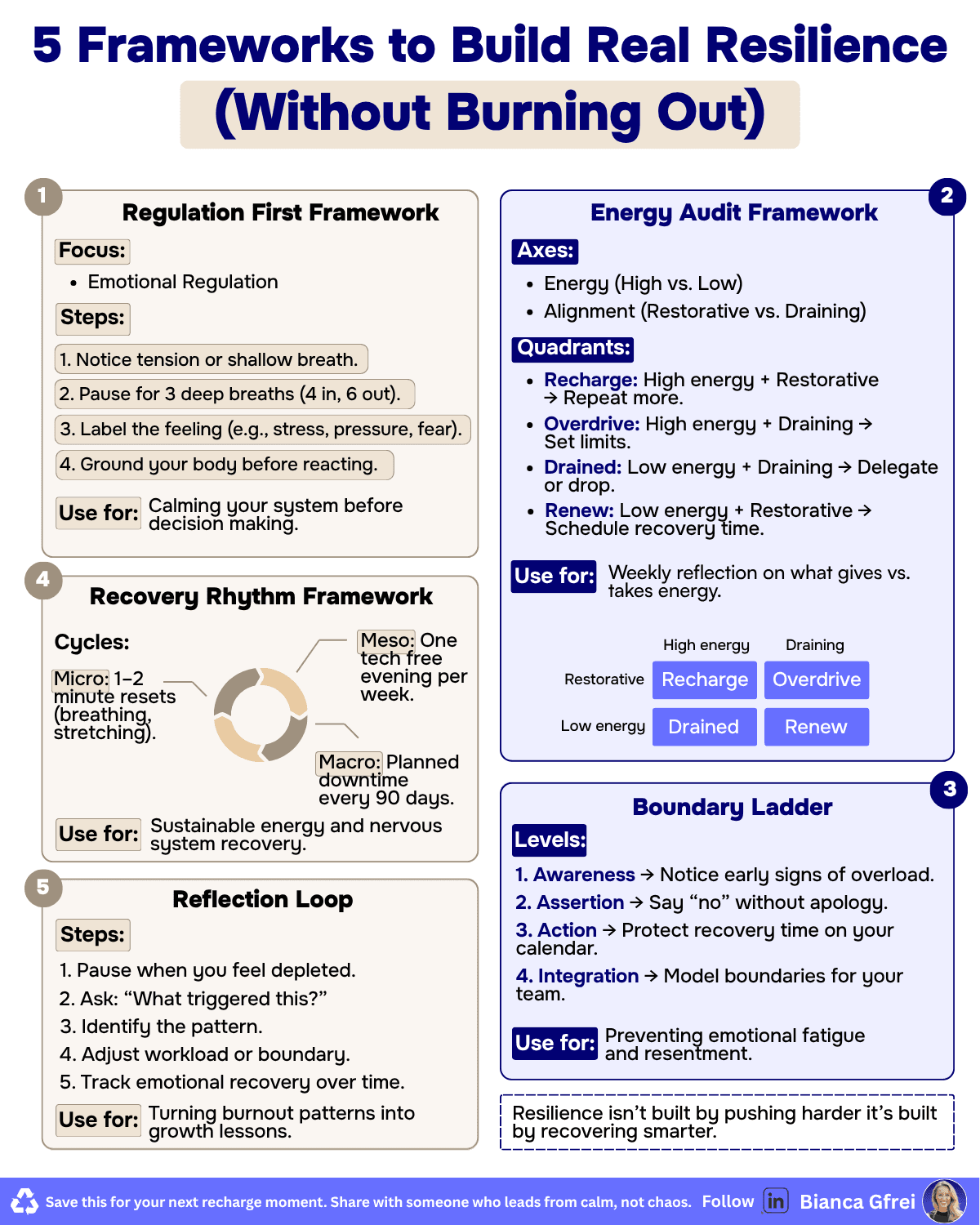
You've heard it a thousand times:
"Build resilience. Be gritty. Push through."
The startup world sells resilience as the ability to keep going no matter what. To work longer, sleep less, sacrifice more. To prove you can handle anything by handling everything.
Here's what that version of resilience actually builds:
Burnout, resentment, and a nervous system that's chronically activated.
The founders who last aren't the ones grinding themselves into dust.
They're the ones who've built frameworks for sustainable performance.
They regulate before they react. They track their energy like they track their metrics.
They build recovery into their operating system, not as an afterthought.
Here are five frameworks that actually work.
Framework 1: Regulation First
Focus: Emotional regulation before decision-making
When to use it: Calming your system before making high-impact decisions
You're in a tense moment. An investor challenges your strategy. Your co-founder questions your judgment. A customer cancels unexpectedly. Your nervous system activates immediately - heart racing, mind either blank or spinning, body tight.
This is the moment that determines everything. React now, and you'll make it worse. Regulate first, and you can respond with clarity.
The steps:
Notice tension or shallow breath
Pause for 3 deep breaths (4 seconds in, 6 seconds out)
Label the feeling (stress, pressure, fear)
Ground your body before reacting
This isn't about suppressing the emotion. It's about creating space between the trigger and your response. That space is where your power lives.
Most founders skip straight to reaction. The regulated ones pause. Three breaths sounds simple because it is. Simple doesn't mean easy when your system is screaming at you to respond immediately.
Framework 2: Energy Audit
Focus: Understanding what gives vs. takes energy
When to use it: Weekly reflection on energy patterns
This framework changed how I think about productivity entirely. Most founders optimize for output. The smart ones optimize for energy.
Your energy operates on two axes:
Vertical axis: High energy vs. Low energy
Horizontal axis: Restorative (gives energy) vs. Draining (takes energy)
This creates four quadrants:
Recharge (High energy + Restorative): This is your sweet spot. Activities that energize you while you do them. For me, it's strategic thinking time, certain types of coaching conversations, moving my body. These activities fuel you. Do more of them.
Overdrive (High energy + Draining): You're performing, but it's costing you. Back-to-back meetings, networking events where you're "on," handling crises. You can do these, but set limits. You're spending down your reserves.
Drained (Low energy + Draining): This is the danger zone. Administrative tasks you hate, misaligned partnerships, conversations that leave you depleted. Delegate or drop these as quickly as possible.
Renew (Low energy + Restorative): Recovery activities. Rest, nature, quiet time, sleep. You're not producing, but you're restoring capacity. Schedule these intentionally - they're not luxuries, they're requirements.
How to use it: Every Sunday, map your previous week's activities into these quadrants. Then ask: Where am I spending most of my time? Am I living in Overdrive? Have I scheduled any Renew time?
The pattern I see most often: Founders spend 80% of their time in Overdrive and Drained, 20% in Recharge, and 0% in Renew. Then they wonder why they're burned out.
Real resilience means protecting Recharge time and scheduling Renew time with the same discipline you schedule investor meetings.
Framework 3: Boundary Ladder
Focus: Progressive boundary setting to prevent emotional fatigue and resentment
When to use it: Preventing emotional fatigue and resentment
Boundaries aren't binary - you don't go from having none to having perfect ones. They develop in stages. Most founders skip the first three levels and try to jump straight to enforcement, which is why it fails.
Level 1: Awareness - Notice early signs of overload. You can't set boundaries around what you can't see. Start tracking when you feel resentful, overwhelmed, or depleted. Those feelings are data showing you where boundaries are missing.
Level 2: Assertion - Say "no" without apology. This is where most founders get stuck. You've noticed the pattern, but actually saying no feels impossible. Practice with lower-stakes situations first. "No, I can't take that call." Not "I'm so sorry, I'd love to but..." Just clear, simple no.
Level 3: Action - Protect recovery time on your calendar. Block it. Make it visible. Treat it as unmovable. If you wouldn't cancel an investor meeting for a random request, don't cancel your recovery time either.
Level 4: Integration - Model boundaries for your team. This is the final stage and the most important. Your team watches how you treat your own boundaries. If you're always available, you're teaching them that boundaries don't matter. When you protect yours, you give them permission to protect theirs.
Start at Level 1. Most founders are trying to enforce boundaries they've never clearly identified. Spend a week just noticing where you need them. Then move to assertion.
Framework 4: Recovery Rhythm
Focus: Building sustainable energy and nervous system recovery through rhythmic rest
When to use it: Sustainable energy and nervous system recovery
Your nervous system needs predictable recovery cycles. Not "I'll rest when this sprint is over." Structured rhythms that your body can count on.
Micro (1-2 minute resets): Breathing, stretching between meetings, standing up and moving. These tiny resets prevent activation from accumulating. Take one between every meeting. Just one minute of intentional breathing resets your nervous system before the next demand.
Meso (One tech-free evening per week): A complete break from work mode. No laptop, no Slack, no "just checking email." One evening where you're fully offline. This isn't vacation - it's routine maintenance. Your system needs to know that downtime is coming regularly.
Macro (Planned downtime every 90 days): Actual time off. Not working-from-the-beach. Real rest. This is how you prevent the crashes that come from months of continuous activation. Quarterly recovery isn't optional - it's strategic.
The pattern that kills founders: They skip Micro because "it's just a minute," ignore Meso because "I'll rest this weekend," and never plan Macro because "we're too busy." Then they crash hard and lose weeks recovering.
Build the rhythm before you need it. Your nervous system learns to trust recovery when it's predictable.
Framework 5: Reflection Loop
Focus: Turning burnout patterns into growth lessons
When to use it: When you notice depletion or resentment building
Most founders move so fast they never process what's happening. Something depletes them, they push through, and they never pause to understand why. The pattern repeats until it becomes a crisis.
The Reflection Loop breaks this cycle.
The steps:
Pause when you feel depleted (don't push through automatically)
Ask: "What triggered this?" (specific situation, person, commitment)
Identify the pattern (Is this the third time this month? What's the common thread?)
Adjust workload or boundary (What needs to change? What can you delegate, decline, or restructure?)
Track emotional recovery over time (Is this pattern improving or persisting?)
This framework transforms burnout signals from problems into information. Instead of "I'm exhausted again, something's wrong with me," it becomes "I'm exhausted because I said yes to three things that should have been nos. Next week, I'll use my decision filter before agreeing."
Example from my own practice: I noticed I felt completely drained after certain types of investor calls. Not all of them - specific ones. When I reflected, I realized it was calls where I felt I had to perform rather than be authentic. The pattern: I was saying yes to investors who weren't aligned, then exhausting myself trying to convince them.
The adjustment: I started declining early conversations with investors whose values didn't match ours. Fewer calls, way less depletion.
The Reflection Loop turns experience into wisdom. Without it, you're just accumulating damage.
Why These Frameworks Work Together
Each framework addresses a different aspect of sustainable performance:
Regulation First handles the moment-to-moment activation Energy Audit helps you understand your patterns Boundary Ladder gives you the structure to protect yourself Recovery Rhythm builds in the actual recovery time Reflection Loop ensures you're learning and adjusting
Most founders try one framework, don't see immediate results, and give up. Real resilience isn't built with one tool - it's built with a system.
You don't need to implement all five at once. Start with the Energy Audit - map one week. See where your energy actually goes. Then add Regulation First for high-stakes moments. Build from there.
What Real Resilience Actually Looks Like
Here's what I learned building two venture-backed companies: The version of resilience I was taught almost destroyed me. Push through pain. Work through weekends. Prove your commitment by sacrificing everything.
That's not resilience. That's self-destruction with good PR.
Real resilience is waking up and knowing your body's state before you check your phone. It's pausing before an important decision to make sure you're regulated. It's declining opportunities that drain you even when they look good on paper. It's scheduling recovery time and protecting it like revenue depends on it - because long-term, it does.
The frameworks above aren't theory. They're what I use, what I teach, and what actually keeps founders functional under conditions that would break most people.
But here's the honest truth: Reading these frameworks won't build resilience. Understanding them intellectually won't either. Resilience is built through practice, repetition, and often support.
You'll know you need help when you've tried implementing these frameworks and keep defaulting back to old patterns. When awareness doesn't translate to action. When you understand what you should do but can't seem to do it consistently.
That's not failure. That's normal. These patterns are deep. They're connected to beliefs about worth, safety, and what it means to be a founder. Shifting them alone is hard.
Resilience isn't built by pushing harder. It's built by recovering smarter.
— Bianca
Go deeper
Download the
CheatSheat
Ready to Upgrade Your Founder OS?
If you're recognizing yourself in these patterns and ready for more than quick fixes, the REWIRED program applications open January 2026. Six months of nervous system work, emotional mastery, and founder community.
Applications open January 2026 - Cohort starts March 2026