Conscious Leadership
Boundaries & Communication
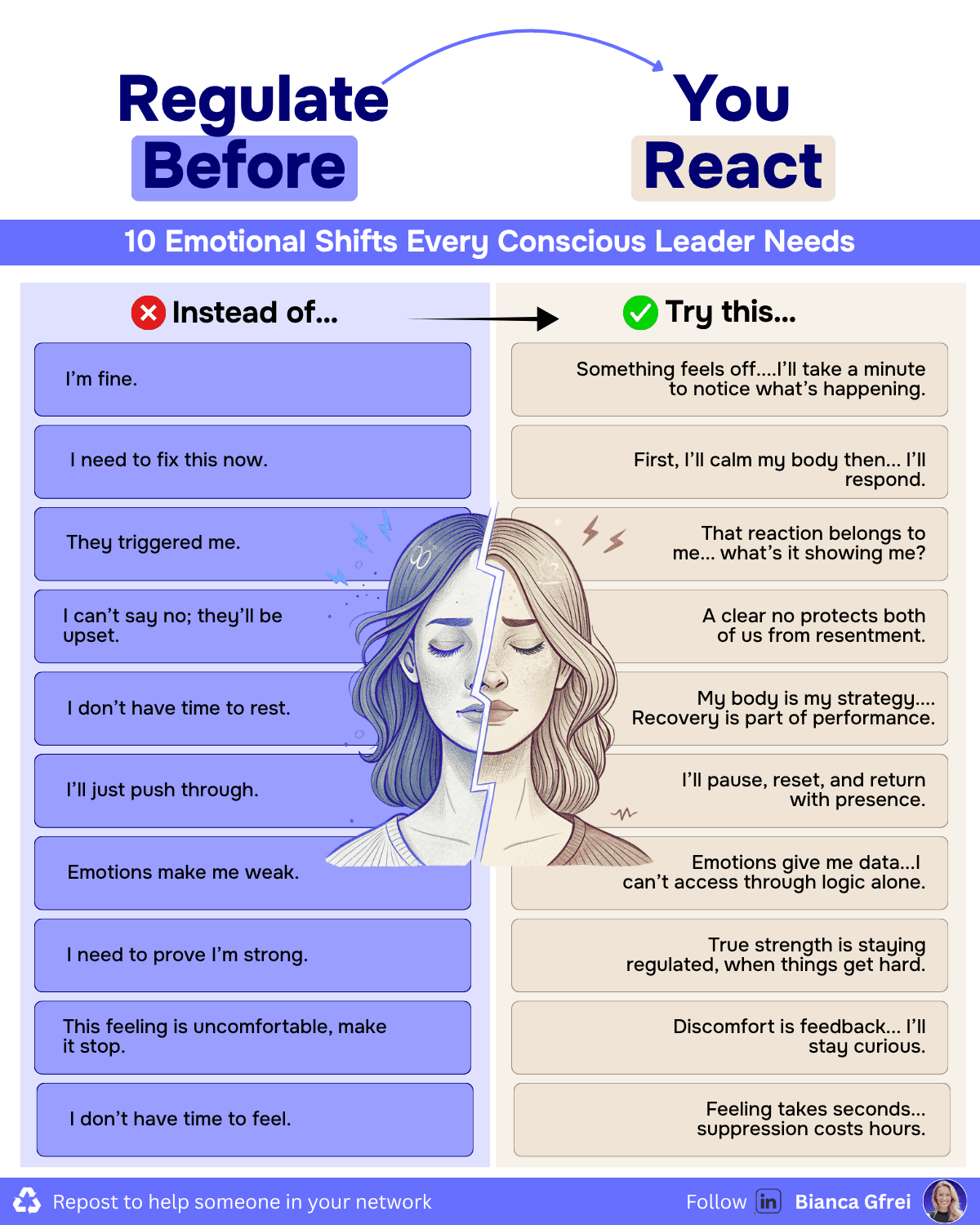
10 Emotional Shifts Every Conscious Founder Needs
How to Stop Reacting and Start Leading
You're in a meeting and someone challenges your decision. Your chest tightens. Your mind goes blank or races with defensive responses. You say something you regret, or you say nothing and stew for hours afterward.
Sounds familiar?
Here's what's happening: Your nervous system is running the show.
Not your strategy, not your leadership skills - your activated nervous system.
And until you learn to work with it, you'll keep reacting from patterns that don't serve you.
Why Most Leadership Advice Misses the Point
The startup world tells you to "stay calm under pressure" and "don't take things personally." As if that's a choice you can just make.
Here's what that advice misses: You can't think your way into regulation. When your nervous system perceives threat - whether it's a tough question from an investor or tension with your co-founder - your body responds before your conscious mind gets a say. Your heart rate increases, stress hormones flood your system, and suddenly that reasonable response you planned? Gone.
The old patterns - pushing through, proving yourself, avoiding discomfort - those are nervous system strategies. They kept you safe once. Now they're keeping you reactive.
The Ten Shifts That Change Everything
These aren't affirmations. They're not things to think about. They're nervous system retraining - shifting from reactive patterns to conscious leadership.
1. From "I'm fine" to "Something feels off - I'll take a minute to notice what's happening"
"I'm fine" is often your nervous system's first line of defense. It keeps you moving so you don't have to feel. The shift is pausing long enough to actually check in. What's happening in your body right now? This isn't indulgence - it's data collection.
2. From "I need to fix this now" to "First, I'll calm my body then I'll respond"
Your nervous system in threat mode wants immediate action. But decisions made from activation usually create more problems. The shift is recognizing that the few minutes it takes to regulate will save you hours of cleanup later.
3. From "They triggered me" to "That reaction belongs to me - what's it showing me?"
When you blame others for your reactions, you stay stuck. The shift is owning your response. Not as self-criticism, but as information. What old wound just got activated? What boundary got crossed? Your reactions are messengers.
4. From "I can't say no; they'll be upset" to "A clear no protects both of us from resentment"
People-pleasing feels like kindness but it's often fear. Fear of conflict, of disappointing others, of not being liked. The shift is understanding that unclear boundaries damage relationships more than honest ones. Your resentment will leak out eventually.
5. From "I don't have time to rest" to "My body is my strategy - recovery is part of performance"
This is the hardest shift for founders. Rest feels like falling behind. But here's what we're learning: Your nervous system can't distinguish between actual threats and perceived ones. Without recovery time, you're running on a system that thinks it's in constant danger. Strategy requires a regulated nervous system.
6. From "I'll just push through" to "I'll pause, reset, and return with presence"
Pushing through works. Until it doesn't. The shift is recognizing the cost of override. Every time you push past your body's signals, you're training your nervous system that its messages don't matter. Eventually, it stops sending subtle signals and starts sending loud ones.
7. From "Emotions make me weak" to "Emotions give me data I can't access through logic alone"
Founders are taught to be rational, logical, data-driven. But your emotions are data. They tell you when something's misaligned, when a relationship isn't working, when you're compromising your values. The shift is learning to listen without being controlled by them.
8. From "I need to prove I'm strong" to "True strength is staying regulated when things get hard"
Strength isn't powering through. It's staying present when your system wants to fight, flee, or freeze. It's being able to sit with discomfort without immediately reacting. That's the leadership edge most founders are missing.
9. From "This feeling is uncomfortable - make it stop" to "Discomfort is feedback - I'll stay curious"
Your nervous system is wired to avoid discomfort. But growth lives in discomfort. The shift is from resistance to curiosity. What is this discomfort trying to tell you? This doesn't mean seeking out pain - it means not running from necessary feelings.
10. From "I don't have time to feel" to "Feeling takes seconds - suppression costs hours"
This might be the most important shift. You think you're saving time by pushing feelings aside. But suppressed emotions don't disappear - they accumulate. They show up as irritability, decision fatigue, insomnia, physical tension. The few seconds it takes to acknowledge a feeling saves hours of downstream consequences.
What Actually Changes These Patterns
Reading these shifts won't change your patterns. Understanding them intellectually won't either.
Here's what actually works: Practice. Repetition. Catching yourself in the old pattern and consciously choosing the new one. Again and again.
Your nervous system learned the old patterns through repetition - probably over years or decades. You learned that productivity equals safety. That your needs come last. That vulnerability is dangerous. These weren't conscious choices. They were adaptations.
Unlearning them requires the same thing: repetition. But this time, conscious repetition.
Some practices that support this work:
Notice Your Patterns in Real Time Start tracking when the old responses show up. What situations trigger "I'm fine" when you're not? When do you say yes when you mean no? You can't change what you can't see. Keep a simple log for one week - you'll be surprised what emerges.
Practice the Pause Between stimulus and response, there's a space. That's where your power lives. Start with just one situation per day where you practice pausing before reacting. Three breaths. Notice what's happening in your body. Then respond.
Work with Your Body, Not Just Your Mind These shifts aren't cognitive exercises. They're somatic retraining. Your body holds the patterns. Walking, stretching, shaking out tension after a hard conversation - these aren't luxuries. They're how you complete the stress cycle and reset your system.
But here's the reality: If these patterns are deeply ingrained - and for most founders, they are - you'll probably need support. A community of others doing this work. Someone who can mirror back what you can't see in yourself. Structured practice that goes beyond reading about it.
The work of shifting from reactive to conscious leadership isn't something you do once. It's a practice you return to again and again. And it's worth it.
Because the alternative - staying stuck in patterns that no longer serve you, leading from a chronically activated nervous system, burning through relationships and your own well-being - that costs more than you realize.
The leaders who thrive aren't the ones who never get activated. They're the ones who've learned to regulate before they react.
— Bianca
Go deeper
Download the
CheatSheat
Ready to Upgrade Your Founder OS?
If you're recognizing yourself in these patterns and ready for more than quick fixes, the REWIRED program applications open January 2026. Six months of nervous system work, emotional mastery, and founder community.
Applications open January 2026 - Cohort starts March 2026