Conscious Leadership
What VCs Can Do to Actually Support Founder Mental Health
The Support Gap That's Costing Your Portfolio
A founder misses a target.
A board call gets tense.
A co-founder conflict suddenly escalates.
This is usually when concern starts. But this isn’t where founder capacity breaks.
It’s where the damage becomes visible.
Founder capacity doesn’t collapse overnight. It degrades predictably under sustained pressure – long before burnout becomes visible.
What you’re seeing in these moments isn’t a lack of resilience or commitment.
It’s founders operating under sustained nervous system load without the capacity infrastructure to recover, regulate, and think clearly under pressure.
This is why founder mental health is one of the most underestimated – and unpriced – risks in venture portfolios.
The Reality Behind Founder Failure
The data is clear: 72% of founders report mental health concerns. People problems (particularly co-founder conflict) are among the top reasons startups fail, with 65% of high-potential startups failing due to founder team issues. Founders face significantly elevated mental health risks, including depression rates twice that of the general population.
Yet when founders break, the ecosystem defaults to individual blame: "They couldn't handle the pressure." "They weren't resilient enough." This framing misses the point entirely.
Founder mental health isn't a personal weakness – it's leadership infrastructure. And it directly impacts the metrics you care about: decision quality, execution speed, team retention, capital efficiency. When founders operate from chronic nervous system dysregulation, failure becomes predictable.
Impaired executive function leads to missed pivots and bad hires. Relational breakdown creates co-founder conflict. Isolation at the top compounds decision failure. These dynamics degrade portfolio performance long before burnout becomes visible.
Most VCs are aware of this. Many genuinely care. But here's the reality: in a 2025 Sifted survey of 138 European founders, 56% reported receiving absolutely no support from their investors when it comes to mental health. Only 3.6% said they received meaningful help. And the broader picture is even starker: 75% of founders experienced anxiety in the last year. 54% burned out. Two thirds considered leaving their startup entirely.
The gap between awareness and action is wide. And it's costing you returns.
What VCs Think Helps – And What Actually Does
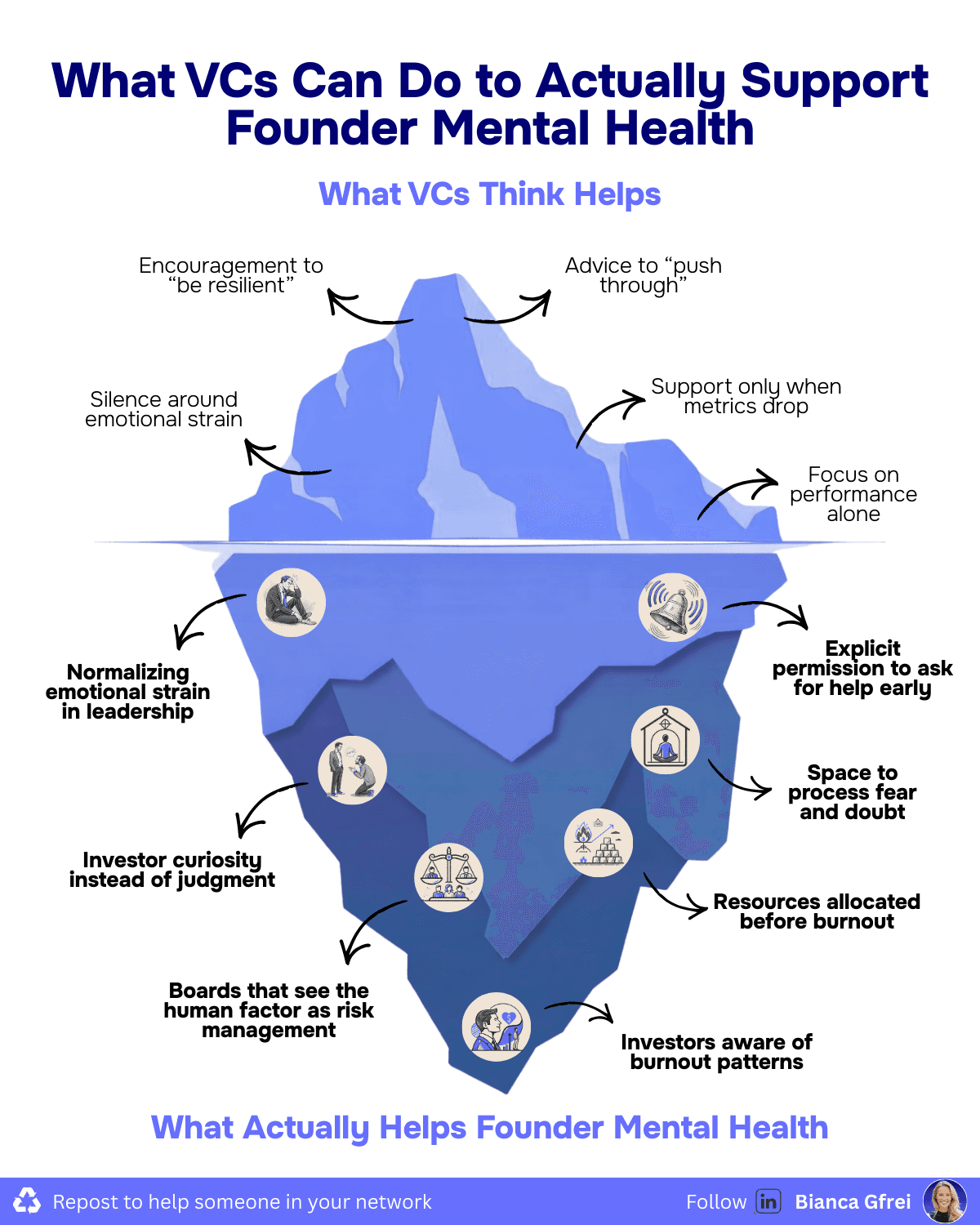
The gap between good intentions and effective support is visualized perfectly in our research with 500+ VC-backed founders: Most VCs believe they're helping through conventional approaches. But these surface-level interventions miss the deeper dynamics that determine whether founders thrive or break.
What Most VCs Think Helps (But Doesn't)
1. Silence Around Emotional Strain
The default culture is "don't talk about it." Emotional difficulty stays private. Founders learn quickly that admitting struggle risks being seen as weak or incapable.
When the norm is silence, founders operate in isolation. They can't reality-test whether their stress is normal. They can't access support before crisis. And they internalize their challenges as personal failure.
The problem: Silence doesn't protect founders – it accelerates their decline.
2. Encouragement to "Be Resilient"
When founders show signs of strain, the most common response is some variation of "you've got this" or "you're strong enough to handle this." It sounds supportive. But it's actually dismissive.
Being told to be resilient when you're already exhausted signals that your struggle isn't legitimate. That you should be able to manage alone. That needing help means you're not cut out for this.
The problem: "Be resilient" is willpower advice for a nervous system problem.
3. Advice to "Push Through"
The startup ecosystem celebrates grinding. "Whatever it takes." 100-hour weeks. No breaks until you hit the milestone. Exhaustion as proof of commitment.
This isn't just unhelpful. It actively creates the conditions for failure. When founders push past their body's warning signals, they don't build capacity. They degrade it. Performance doesn't improve. It collapses.
The problem: Founders who keep pushing until they break. Portfolio value destroyed by preventable human system breakdown.
4. Support Only When Metrics Drop
Most VCs wait for visible crisis before intervening: missed targets, co-founder blowups, obvious burnout. By then, you're managing consequences, not preventing them.
Founder capacity doesn't collapse overnight. It degrades predictably with clear warning signs. But when support only appears after metrics suffer, you're already in damage control.
The problem: The time to install a founder operating system isn't when they're drowning – it's from the moment they step into pressure.
5. Focus on Performance Alone
Most boards track revenue, runway, and growth metrics religiously but miss the leading indicators of founder capacity decline.
When founders become reactive, rigid, or relationally strained, it's treated as a performance issue rather than a nervous system signal. Sleep disruption, emotional numbing, decision rigidity – all dismissed until they impact the numbers.
The problem: By the time performance metrics suffer, the founder's capacity has been degrading for months. You're late.
What Actually Helps (Below the Surface)
The research is clear: effective founder support happens at a different level entirely. It's not about adding perks. It's about changing how you engage with the humans building your portfolio value.
1. Normalizing Emotional Strain in Leadership
Emotional strain isn't a red flag – it's inherent to high-stakes leadership. What matters is whether founders have permission to acknowledge it.
What this looks like:
Creating space for honest answers beyond "all good"
Allowing difficulty without immediately turning it into a performance problem
Separating emotional strain from competence judgments
Normalizing strain doesn't lower standards. It increases psychological safety and decision quality.
2. Investor Curiosity Instead of Judgment
When founders struggle, most feel evaluated. Curiosity replaces that dynamic.
What this looks like:
Asking how pressure is landing, not just what isn't working
Exploring context before prescribing solutions
Staying present instead of jumping into fixing mode
Curiosity regulates. Judgment dysregulates.
3. Boards That Treat Human Factor as Risk Management
The best boards track founder capacity as seriously as they track burn rate because it's just as predictive of failure.
What this looks like:
Noticing when reactivity, fatigue, or rigidity increase
Understanding that declining decision quality is often biological, not strategic
Addressing capacity signals with the same seriousness as financial risk
This isn't about being softer. It's about being earlier.
4. Investors Aware of Burnout Patterns
Burnout doesn't appear suddenly. It follows clear, observable patterns – if you know what to look for.
What this looks like:
Recognizing sleep disruption, emotional numbing, and decision rigidity as early signals
Understanding co-founder conflict as accumulated nervous system load
Asking different questions when founders seem "off"
When investors understand the biology, they stop prescribing willpower solutions to nervous system problems.
5. Resources Allocated Before Burnout
Capacity-building happens proactively, not reactively. It's infrastructure, not emergency response.
What this looks like:
Funding or subsidizing evidence-based capacity programs (somatic work, nervous system training)
Making access frictionless and stigma-free
Treating prevention as portfolio infrastructure, not a founder perk
Burnout prevention is significantly cheaper than leadership replacement.
6. Space to Process Fear and Doubt
Fear and doubt aren't obstacles to good leadership, they're data. The question isn't whether founders experience them, but whether they have space to process them without being judged as incompetent.
What this looks like:
Creating conversations where uncertainty can be named
Separating fear from decision-making capability
Allowing founders to work through doubt without it being weaponized against them
When fear has no safe outlet, it drives reactive decisions. When it can be processed, it becomes useful information.
7. Explicit Permission to Ask for Help
Support isn't something founders access after proving they need it. It's available from day one, normalized as smart leadership, not weakness.
What this looks like:
Making resources available without requiring justification
Framing early support as professional leadership capacity-building
Offering access proactively, not reactively
If founders have to wait until something is visibly wrong, you're already late.
The pattern is clear: Surface-level interventions treat symptoms. Deep support addresses root causes.
Most VCs focus on what's visible above the waterline. The ones getting results understand what's happening below.
What Progressive VCs Are Already Doing
A growing number of VCs are pioneering this deeper approach. Here's what's working and what you can steal.
Balderton Capital: Infrastructure, Not Afterthought
In 2023, Balderton became one of the first European VCs to launch a comprehensive Founder Wellbeing and Performance Platform. The six-month program covers physiology, nutrition, fitness, sleep, and mindset – all grounded in data.
Why it works: It treats founder capacity as portfolio infrastructure, not an optional perk. Their own research backs it up: 88% of founders believe investors have a responsibility to support wellbeing; 83% acknowledge that past a certain point, working more hours yields diminishing returns.
What to take from this: Co-invest in evidence-based capacity-building programs. Participation signals seriousness, not weakness.
Northzone: Building Resilience Through Relationship
Northzone runs annual 24-hour founder gatherings focused on resilience — physical, emotional, and relational. The 2023 gathering in Amsterdam centered on "Resilience in Uncertain Times" and included ice baths for stress regulation, structured peer coaching sessions on leadership and personal challenges, and experiential learning in a confidential setting.
Why it works: Resilience isn't built individually. It's built relationally. Peer normalization reduces isolation and stress-driven decision distortion. When founders see others struggling with similar challenges, they stop internalizing it as personal failure.
What to take from this: Create regular, facilitated founder-only spaces where performance talk is replaced with shared experience and honest reflection.
Other VCs Leading the Way
Ananda Impact Ventures – Founder Health as a Contractual Commitment. Ananda launched a comprehensive Founders' Health Programme in 2023, available to all founders in their active portfolio — including coaching, peer support, and resources. What makes it distinctive: founder health is anchored directly in their termsheet. Wellbeing isn't an add-on. It's part of the deal.
Masawa – Mental Health as the Core Mission of the Fund. Masawa is the world's first mental wellness-focused impact fund. Their "Nurture Capital" approach treats founder wellbeing explicitly as risk minimization: 65% of startups fail due to people problems. When mental health is non-negotiable, founders don't have to justify care, it's already legitimized.
The Four Patterns Behind What Actually Works
Looking across VCs who are getting this right, four consistent patterns emerge:
1. Proactive Over Reactive: Support happens before crisis, not after. Install the operating system before pressure peaks.
2. Structural Over Individual: Recognize that founder burnout is a system issue, not personal failure. Change the conditions, not just the founder.
3. Biology-Based Over Mindset-Only: Ground support in nervous system science, somatic intelligence, and emotional regulation. You can't out-hustle biology.
4. Relational Over Transactional: Build genuine partnership where founders can bring the full reality of their experience without fear of judgment.
This Is Infrastructure, Not Optional
Here's what we know from years of working with VC-backed founders: the ones who thrive aren't the ones who push harder.
They're the ones who learn to work with their biology, not against it.
As a VC, you have more influence over this than almost anyone else in the startup ecosystem. Your founders look to you for signals: what matters, what's acceptable, what success actually looks like.
When you normalize conversations about founder mental health, you give permission to be human. When you fund capacity-building, you reduce one of the largest — and most preventable — risks in your portfolio.
This isn't soft. It's strategic leadership infrastructure.
Regulated founders make better decisions. Emotionally intelligent teams execute faster. Sustainable leaders build more valuable companies.
Start with one shift. Then another.
Founder burnout isn’t a personal failure. It’s what happens when we expect human nervous systems to operate like machines.
— Bianca
Go deeper
Download the
CheatSheat
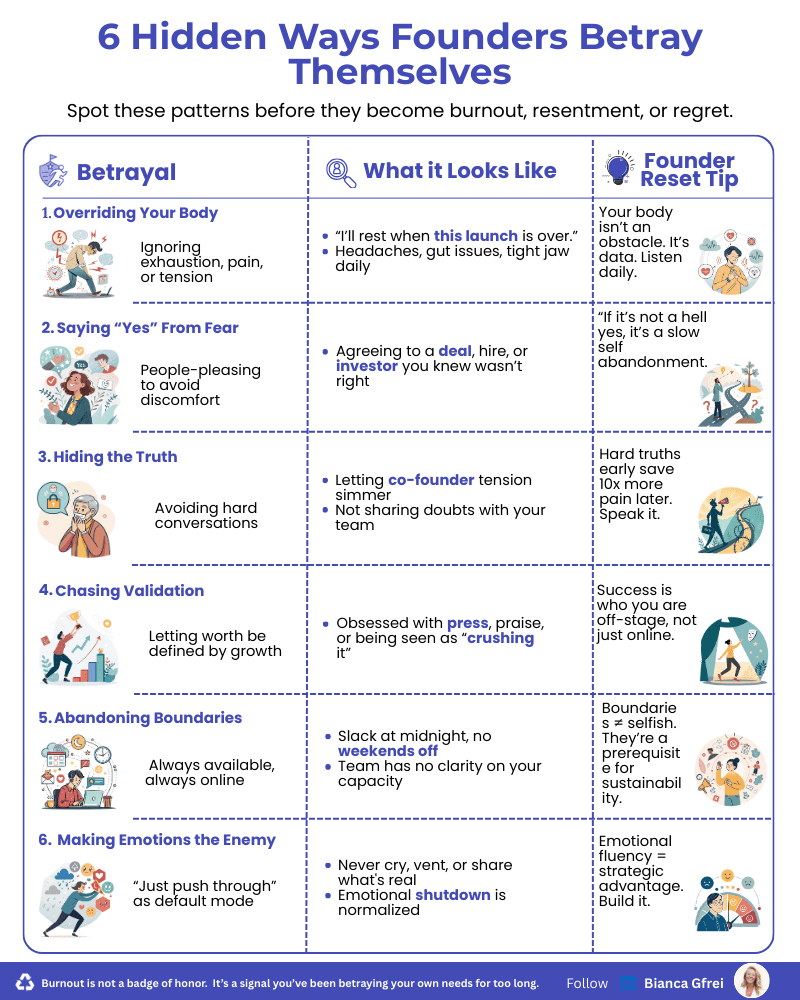
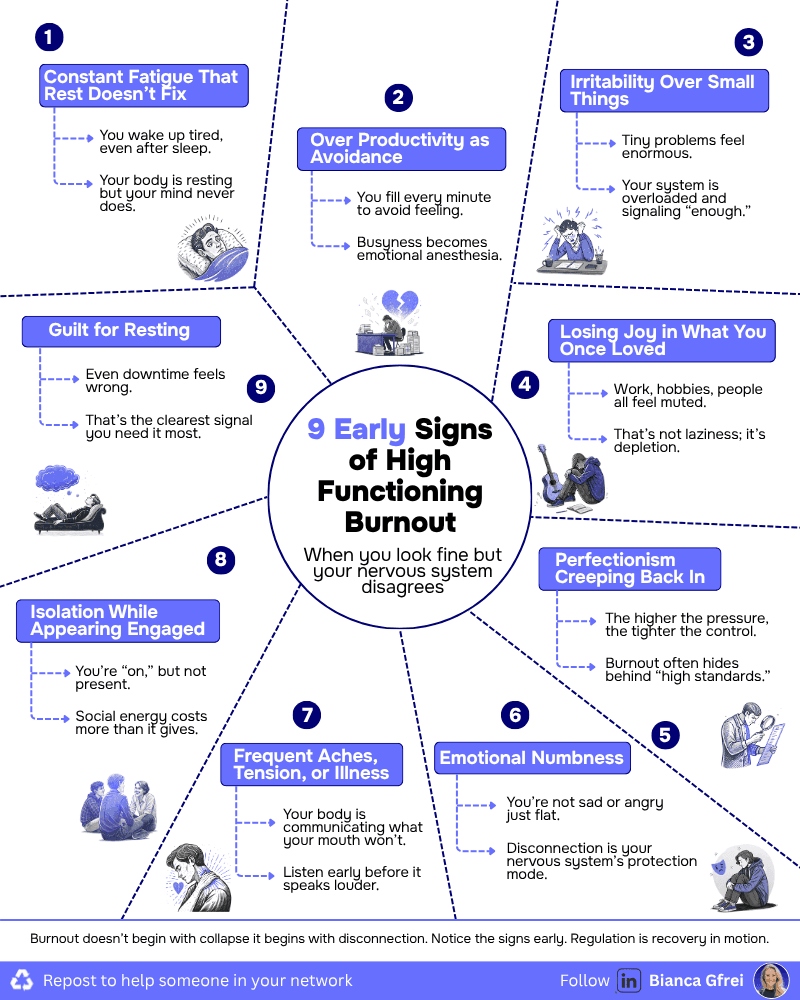
Ready to Upgrade Your Founder OS?
If you're recognizing yourself in these patterns and ready for more than quick fixes, the REWIRED program applications open January 2026. Six months of nervous system work, emotional mastery, and founder community.
Applications open January 2026 - Cohort starts March 2026